Skin Rejuvenation - Laser
Skin Rejuvenation – Fractional
Skin Rejuvenation – IPL
Skin Rejuvenation – Chemical Peel
Skin Rejuvenation – Botulinium
Facial Augmentation & Reshaping
Facial Lines & Wrinkles
Acne Control Program
Advanced Scar Revision
Pigmentation Reversal
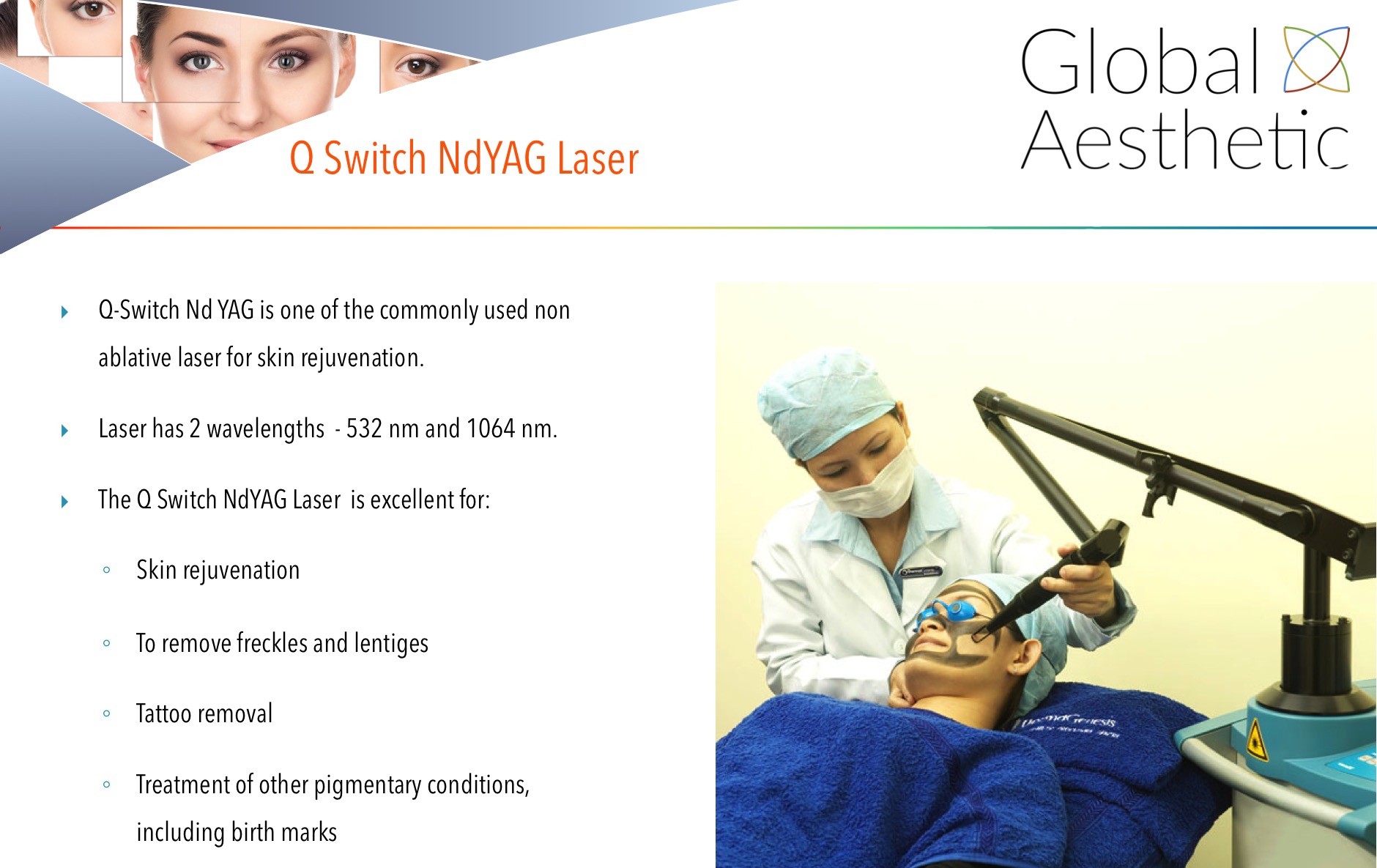
Introduction Non-Ablative Laser Skin Rejuvenation involves a series of Laser treatments done at regular interval to exfoliate and rejuvenate the skin. The facial skin is sensitive and requires a more delicate set of Lasers. There are more than 90 Lasers to choose from for Aesthetic procedures, with each Laser having its scopes and purposes. Our Doctors will select the Laser based on your skin type, skin condition, chromophore and depth of chromophore. Chromophores are proteins within the skin, which are targeted by the Laser beam in order to exfoliate and rejuvenate the skin.
Types of LaserCommonly used Non-Ablative Lasers for Asian skin are Q-Switch NdYAG Laser at 532 nm and 1064 nm, Long Pulsed Alexandrite Laser at 755 nm, Long Pulsed Diode Laser at 810 nm, Long Pulsed NdYAG Laser in Free Running Mode and Pulsed Dye Laser at 510 nm, 530 nm and 560 nm (nm denotes nanometers, which is a measurement of wavelength).
UsesLaser Skin Rejuvenation is ideal to treat the face and the body for acne, scars, pigmentation, dull skin and other unfavorable skin conditions. After a few treatments, the skin will appear clearer, evenly toned, firmer, less oily and radiant.
Adverse effectsThe Laser sensation during the treatment is normally bearable. However, for those with lower tolerance, the skin can be prepared with an anesthetic cream to numb the skin before the procedure. The skin will appear red immediately after the treatment. There might be some light to medium scabs for few days after which the skin will be clearer and radiant.
CostClients normally require 4 to 6 treatments, depending on their skin condition and tolerance to the treatment. The treatments are initially done once in 3 to 4 weeks and later reduced to once in 2 months. The cost ranges from RM 450 to RM 540 per treatment, depending on the type of Laser used.
Laser GalleryIntroduction Fractional Laser has revolutionized Laser Skin Rejuvenation procedures. Fractional Laser beams create minute punctures onto the skin, where the depth, size and the number of puncture can be adjusted depending on the skin type and skin condition. The punctured areas are replaced by a new line up of healthy cells. Repeated treatments will eventually replace the unhealthy and aged cells with a newer layer healthy cells.
Types of Laser Commonly used Ablative Fractional Lasers for Asian skin are Fractional CO2 Laser at 10,600 nm and ErYAG Laser at 2940nm. Other Fractional Lasers include ErGlass at 1355 nm and 1550 nm.
UsesAblative Fractional Laser is ideal to treat acne, scars, open pores and pigmentation, including dermal collagen remodeling and skin tightening. It can also be used to treat stretch marks on the abdomen, thighs and hips. After a few treatments, the skin will appear clearer, evenly toned, firmer, less oily and radiant.
Adverse effectsThe Laser sensation during the treatment is normally bearable. However, for those with lower tolerance, the skin can be prepared with an anesthetic cream to numb the skin before the procedure. The skin will appear red immediately after the treatment. There might be some light to medium scabs for few days after which the skin will be clearer and radiant.
Cost Clients normally require 4 to 6 treatments, depending on their skin condition and tolerance to the treatment. The treatments are initially done once in 3 to 4 weeks and later reduced to once in 2 months. The cost ranges from RM 450 to RM 540 per treatment, depending on the type of Laser used.
Fractional Laser GalleryIntroductionIPL Skin Rejuvenation is a light based treatment, which distributes intense light energy into the deeper layers of the skin without harming the epidermis. IPL energy is absorbed by dull pigment cells and become fragmented. As a process called phagocytosis clears the fragmented pigment cells, the light energy simultaneously stimulates new cell growth and helps to rejuvenate the skin.
Wavelengths Commonly used wavelengths in IPL treatments are 560 nm for skin rejuvenation, 580 nm for deep pigmentation and 640 nm for hair removal.
UsesIPL is commonly used to treat erythematous acne, spider veins, melasma, solar dyschromia (dull and uneven colored skin due to excessive sun exposure) and open pores. After a few treatments, the skin will appear clearer, evenly toned, firmer, less oily and radiant.
Adverse effectsThe IPL sensation during the treatment is normally bearable. However, for those with lower tolerance, the skin can be prepared with an anesthetic cream to numb the skin before the procedure. The skin will appear red immediately after the treatment. There might be some light to medium scabs for few days after which the skin will be clearer and radiant.
Cost Clients normally require 4 to 6 treatments, depending on their skin condition and tolerance to the treatment. The treatments are initially done once in 3 to 4 weeks and later reduced to once in 2 months. The cost ranges from RM 450 to RM 540 per treatment, depending on the type of IPL used.
IPL GalleryIntroductionChemical Skin Rejuvenation was one of the most popular Aesthetic procedures before the advent of medical devices and Lasers. Chemical peels still have its value in Aesthetic Medicine especially with the new line up of improvised ingredients for a more effective and safer results.
Types of Chemical Peel There are several Chemical peels with the most popular ones being AHA (Alpha Hydroxyl Acid, also known as Glycolic Acid), BHA (Beta Hydroxy Acid, also known as Salicylic Acid), Lactic Acid, TCA peels or combination peels such as Jessner’s peel or Modified Jessner’s peel. Chemical peels help to “de-glue” the skin matrix, allowing a uniform and smooth peeling of the superficial layer of the skin. The skin “de-gluing” process also induces an inflammatory reaction, which allows cell mediators to promote new cell growth.
Uses Chemical peels are cost effective procedures (when compared to Laser devices) in removing blackheads / whiteheads and in treating acne, post acne marks, pigmentation and dull skin. After a few treatments, the skin will appear clearer, evenly toned, firmer, less oily and radiant.
Adverse effectsDuring the treatment, there will be a slight burning and itchy sensation. The skin normally appears red immediately after the treatment with some light to medium scabs for few days after. The skin will appear clearer and radiant once the scabs fall off.
Cost Clients normally require 4 to 6 treatments, depending on their skin condition and tolerance to the treatment. The treatments are initially done once in 3 to 4 weeks and later reduced to once in 2 months. The cost is about RM 180 per treatment.
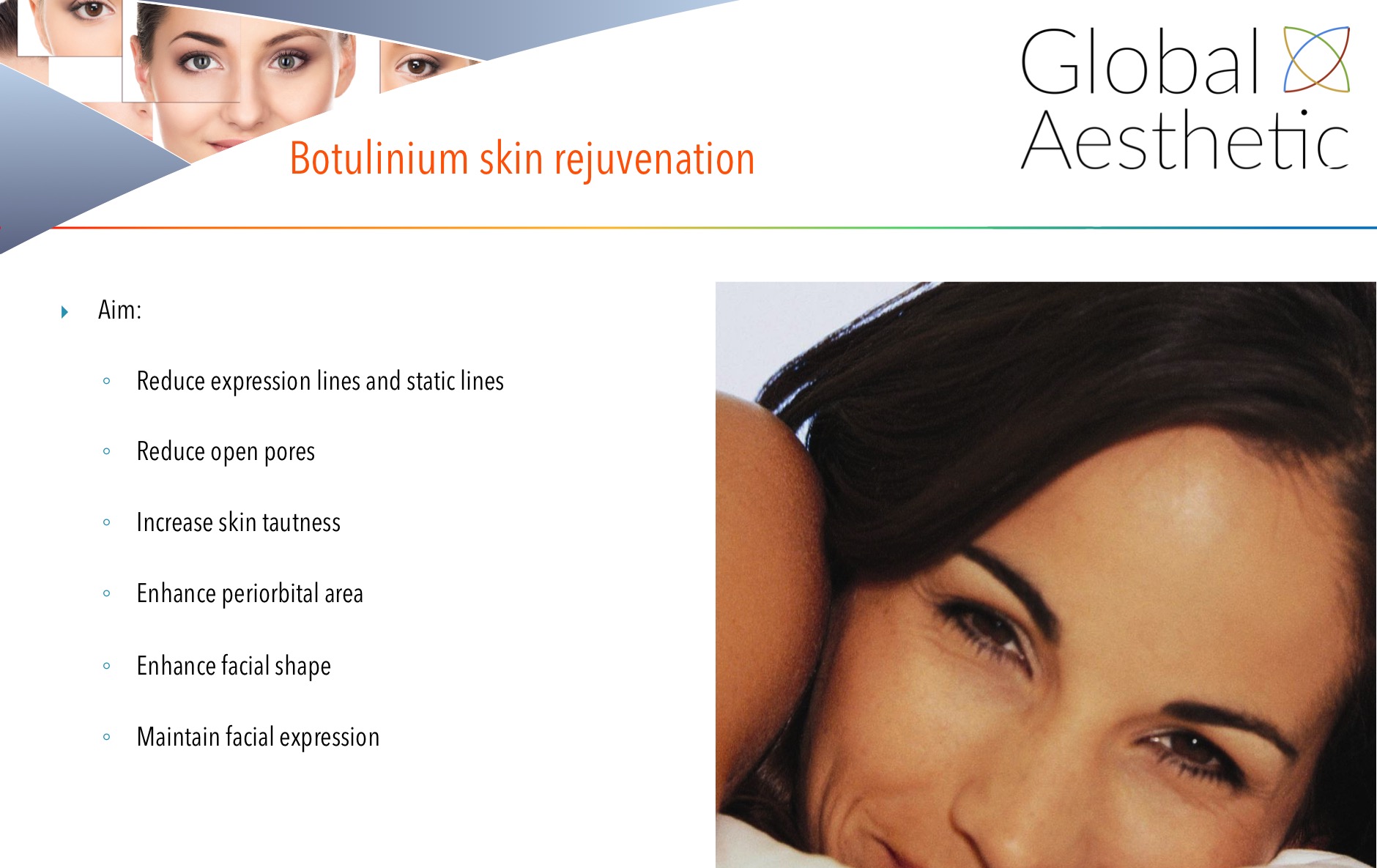
Chemical Peel GalleryIntroductionSkin Rejuvenation using Botulinium Toxin (Dysport or Botox) is a new and advanced approach to rejuvenate aging skin. Botulinium was originally used to relax facial muscle in order to reduce facial lines. However, new evidence suggests that low doses of Botulinum also have skin-rejuvenating effects.
ProcedureThe technique for Botulinium Skin Rejuvenation is unique and the Aesthetic Physician must have through knowledge on the facial muscles and how each of them effects the Client’s expression. Minute amounts of highly diluted BTA are injected into various parts of the face to induce a bio-inflammatory response, which will then help to tighten the SMAS (Sub Muscular Aponeurotic System) layer of the skin along with promoting new cell growth via Cell Mediator Cycle.
Uses Skin Rejuvenation with Botulinium is useful to treat aged and dull looking skin with skin laxity. A week after the treatment, the facial skin will appear firmer and radiant. The result will last for 4 to 6 months, after which the treatment can be repeated.
Adverse effectsThere is a minimal risk of Botulinium diffusion into adjacent muscles causing temporary facial weakness.
CostThe treatment cost ranges from RM 1200 to RM 1800 depending on the amount of Botulinium used.
Botulinium GalleryIntroductionSharper nose, well-bodied lips and perfect chin are preferred anatomical features for both men and women. With Dermal Fillers, these features can now be attained or enhanced in just few minutes without the need for surgery. Similarly, changing a square shaped facial structure to a more oval shaped feature is simply a few minutes procedure with Botulinium injections.
Procedure Dermal fillers are biologically compatible gels that are injected underneath the skin. They are soft, easily molded and have a natural consistency with the skin over the eyes, nose or lips. The gels, once injected, will be in place for almost a year and is biologically degraded by the body. The gels are safe with almost no risk. There are several Dermal Fillers in the market, with the most popular being Hyaluronic Acid gel. Other Dermal Fillers include Calcium based gels such as Aquamid or Alcamids. Dermal Fillers can be used to augment the nose, treat nasal beaks and enhance mid-face area. They can also be used to make the lip more voluminous, sharpen the chin, and enhance the infraorbital area. For males, the gel is injected to enhance the brow and to increase the temporal volume to give a more muscular and well-defined look. The augmentation effects sets in almost immediately. The result lasts for 10 to 12 months or even longer depending on the type of Filler used.
Tiny amounts of Botox or Dysport are injected into the Masseter muscle. The Masseter is the jaw muscle responsible for chewing and crunching. The Neuromodulators will cease muscle activity and the muscle eventually undergoes a physiological condition called hypotrophy – meaning shrinking of the muscle bulk. When the Masseter muscle becomes smaller, the face will appear smaller and adapts an oval shape. The muscle will start to shrink from the 3rd week onwards and reach optimal effect by the 6th week. The result lasts for 4 to 6 months. The longevity defers from person to person with some people enjoying longer benefits than others. The procedure is almost painless and does not require any sedation or anesthetic cream.
Adverse effectsAs in any injectable procedure, there are risks of bleeding or bruising. Other complication, though rare, includes infection, inflammation and granuloma, all of which can be treated.
For Botulinium procedure, the Neuromodulators may diffuse into adjacent muscle and may cause alteration of smile and difficulty in chewing. Fortunately these side effects are temporary and will recover completely in few months. Other rare side effects include breathing difficulty and visual disturbances. If this were to happen, the Client will require hospital care until they recover.
Cost The treatment cost ranges from RM 1800 to RM 2400 depending on the nature of the procedure
Facial-Augmentation GalleryIntroductionReducing facial wrinkles is not just a procedure, but also an art. It is pertinent to analyze the facial lines and understand the Client’s lifestyle and social activities before attempting to treat the lines. In order to obtain optimal and natural looking results, expressive lines are best softened and not paralyzed with Neuromodulators such as Botox or Dysport, while deeper folds are softened with Dermal Filler. Both Botox and Dysport are BoNTA Neuromodulators, which blocks the nerve impulses to the muscles and prevent them from contracting. When the muscles do not contract, the skin overlying the muscle does not crunch, or wrinkle. Dermal fillers are biologically compatible gels that are injected underneath the skin. They are soft, easily molded and have a natural consistency with the skin over the eyes, nose or lips. The gels, once injected, will be in place for almost a year and is biologically degraded by the body. The gels are safe with almost no risk. There are several Dermal Fillers in the market, with the most popular being Hyaluronic Acid gel.
ProceduresThe procedure to reduce facial lines and wrinkles may include Neuromodulators, or Dermal Fillers or both. Tiny injections of Botox or Dysport will be administered superficially into the facial muscles in order to selectively relax the muscles and soften the lines, while preserving facial movements. For deeper folds and lines, Dermal Filler such as Hyaluronic Acid is injected to plump up the skin beneath the lines. The procedure is almost painless and can be done with or without a topical anesthetic cream.
After Botox or Dysport injection, the expression lines will gradually disappear and reach optimal effects within a week. The result lasts for 3 to 6 months. With Dermal Fillers, the deeper folds disappear almost immediately and the effect lasts for 10 to 12 months depending on the type of Filler used. The longevity defers from person to person with some people enjoying longer benefits than others.
Adverse effectsAs in any injectable procedure, there is risk of bleeding and bruising. Rarely the Neuromodulators may diffuse into adjacent muscle and may cause drooping of the eyelid or eyebrow. With Dermal Fillers, there is a minimal risk of forming an inflammatory nodule at the side of injection. These side effects are temporary and will recover with or without medical intervention in few months.
Cost The treatment cost ranges from RM 600 for a small area (such as the Glabella) to RM 1800 for a full face Botox or Dysport procedure. For Dermal Filler the treatment cost ranges from RM 1800 to RM 2400 depending on the amount and type of Filler used.
Facial Lines and Wrinkles GalleryIntroductionAcne is one of the most common skin disorders with more than 90% of the global population burdened by the condition, and with 25% of them having facial disfigurement and socio-psychological complications.
Facts about acne
- Acne is known as a disorder of the Pilosebaceous Unit and is triggered by multiple factors, more often in combination.
- Researchers believe that the tendency to develop acne can be inherited from parents.
- A hormone called androgen stimulates the sebum-producing glands.
- A bacterium called Propionobacterium Acne also provokes an acne breakout.
- Occlusion of the pores at the skin surface by dead cells, make up, thick foundation, mechanical occlusion;
- Occlusion of the sebaceous duct by overgrowth of the cells lining the duct.
- Hyperactivity of the sebaceous glands, in addition to making the skin oily, also triggers off acne.
- Women may get more pimples around the time of their menstrual periods due to hormonal spikes.
- High glycaemic diet can also trigger acne breakout.
- Certain drugs, such as those used to treat epilepsy or tuberculosis; exposure to industrial oils, grease and chemicals; and stress and strong emotions may trigger acne.
ProcedureThe Dermatological approach towards acne management is different from that of Aesthetic Medicine. While clinical dermatologist take steps to treat acne, Aesthetic Physicians take measures to treat acne, along with controlling recurrences, treat scars and rejuvenating the tormented skin.
There are over 100 treatment modalities to manage acne. It ranges from Lasers, IPL, chemical peels, tablets and creams. The tablets include oral antibiotics, contraceptive pills and vitamin A analogs such as Roaccutane, while the creams include topical antibiotics, topical vitamin A analogs and many more. One of the most important treatment factors involves counseling and assuring the patients that there is still hope to treat acne.
Adverse effectsEach and every treatment for acne does have its own adverse effects. It is impossible to list all the treatments and their adverse effects in one page. However, your Aesthetic Physician should be able to highlight the pros and cons of each of the treatments.
Cost Effective acne treatment starts with a detailed consultation and counseling, followed by a treatment plan designed to fit the patient’s lifestyle and economics. It is impossible to design one plan that suits all. Managing acne requires skills, patience and compliance.
The cost depends on the choice of treatment. A cost effective treatment, such as Chemical Peel should cost not more than RM 200 per visit, while Laser based and more sophisticated treatments will cost about RM 500 per visit.
IntroductionScar formation is part of the healing process that occurs following an inflammation. The triggering factors of an inflammatory reaction may be acne, chicken pox, infection, trauma or surgery. During an inflammatory reaction, the underlying collagen structure within the dermis is disrupted. The disruption of collagen network is reflected as a depressed (sunken) part on the surface of the skin. Some scars are small in diameter but deep, while some scars are wide and shallow. These are known as atrophic scars.
On the other hand, hypertrophic or keloid scars occur due to the same triggering factors (inflammatory reaction). However, in hypertrophic scars, the disrupted collagen network is replaced by an overgrowth of dense fibrotic tissue; giving it the elevated, brownish, thick “cord like” scar tissue.
Types of ScarThere are several types of post acne scars – ice pick scars, boxed scars, rolled scars and fibrotic scar. Other scars are following trauma, surgery or post inflammatory reactions, such as chicken pox. Identifying the type of scar is crucial to designing the treatment plan. Fibrotic scars have an underlying base with fibrotic adhesions. The fibrotic adhesion must be released with a simple procedure called “subcision” before starting the Laser treatment.
Procedure Scar revision is a multi-approach treatment concept. It includes a series of high-powered Lasers, normally Fractional CO2 laser, with or without subcision. Subcision is done by introducing a tiny needle underneath the scar to release the fibrous adhesion. Occasionally the laser procedures are combined with PRP injections to help accelerate cell growth.
Hypertrophic scars are treated using steroid injections coupled with air subcision.
Adverse effectsThe Laser sensation during the treatment is normally bearable. However, for those with lower tolerance, the skin can be prepared with an anesthetic cream to numb the skin before the procedure. The skin will appear red immediately after the treatment. There might be some light to medium scabs for few days after which the skin will get clearer and radiant.
Overuse of intralesional steroids may result in thinning of the skin, with hypopigmentation.
Cost Clients normally require 4 to 6 treatments, depending on their skin condition and tolerance to the treatment. The treatments are initially done once in 3 to 4 weeks and later reduced to once in 2 months. The treatment cost ranges from RM 600 to RM 900 depending on the type of Laser used.
Scars GalleryIntroductionPigmentation is one of the most common complaints amongst Asians – a group that is always keen for a fairer and whiter skin, in contrast to the Caucassians who prefer a tanned look. The Asian population is concentrated in the tropical territories and is constantly exposed to detrimental UV rays from the sun. The chronic sun exposure eventually leads to melasma, freckles and lentigos, which often coexist simultaneously in a patient, giving them an unhealthy and dull appearance.
Triggering factors
- The most common triggering factor is the ultraviolet A (UVA) and ultraviolet B (UVB) radiation from the sun. The UV radiation triggers off a chain reaction within the epidermis and dermis that stimulates melanocyte formation by activating the tyrosinase enzyme.
- Melanocyte production increases with age. One theory postulates that the free radical reaction that DNA suffers in aging skin triggers off melanocyte formation.
- Hormone changes such as after pregnancy or oral contraceptive pills stimulates melanocyte formation by activating the tyrosinase enzyme.
- Post inflammatory hyperpigmentation, such as after acne, trauma or burns stimulates melanocyte production.
Procedure Treating pigmentation starts with a detailed history, including that of sun exposure, hormonal manipulation and familial history. The Aesthetic Physician will then need to analyze the type of pigmentation and estimate its depth. Subsequently, the Physician will need to decide on the type of Lasers, its settings and frequency of treatments. The patients also needs to be counseled on sun exposure and using sunblock.
Treatment normally includes a combination of Lasers and IPL. Commonly used Lasers for pigmentation include Q Switch NdYAG Laser at 532 nm for superficial freckles and lentigos, combined with Long Pulsed Alexandrite Laser at 755 nm for the deeper melasma. Occasionally Fractional CO2 lasers are also equally useful for pigmentation in Asian skin.
An article published by Dr Morthy in Journal of Cosmetic Dermatology, year 2006, evidences that Fractional CO2 laser is useful in treating Melasma in Asian skin.
Adverse effectsThe Laser sensation during the treatment is normally bearable. However, for those with lower tolerance, the skin can be prepared with an anesthetic cream to numb the skin before the procedure. The skin will appear red immediately after the treatment. There might be some light to medium scabs for few days after which the skin will get clearer and radiant.
Cost Clients normally require 4 to 6 treatments, depending on their skin condition and tolerance to the treatment. The treatments are initially done once in 3 to 4 weeks and later reduced to once in 2 months. The treatment cost ranges from RM 600 to RM 900 depending on the type of Laser used.
Pigmentation Gallery